

American college students have been the most consistent force behind the redefinition of casual style in the United States for over a century. From the Ivy League’s invention of the preppy aesthetic in the 1920s through the countercultural rebellion of the 1960s, the hip-hop influenced campus style of the 1990s, and the streetwear and quiet luxury movements of the 2010s and 2020s, university campuses have repeatedly been the first place where new ways of dressing casually were tested, refined, and eventually adopted by the broader culture. This happened not because college students were fashion-forward in the traditional sense but because the specific conditions of campus life, the need to move between academic, social, athletic, and public contexts in a single day with limited resources and a strong desire for group identity and individual expression, consistently produced style innovations that addressed needs the mainstream fashion industry had not yet recognised.
The Ivy League and the Birth of American Casual: 1920s to 1950s
The first major instance of American college students redefining casual style came from the elite Ivy League universities of the northeastern United States in the 1920s and 1930s. Students at Harvard, Yale, and Princeton, who had previously been expected to dress in the formal attire of upper-class East Coast society, began developing a distinctly more relaxed interpretation of gentlemen’s clothing that retained its quality and intentionality while becoming more adapted to the physical realities of campus life.
The resulting aesthetic, which would eventually be codified and commercialised as the preppy look, was built around natural fabrics in restrained colours, sport-adjacent pieces adapted for non-athletic wear, and a general principle of quality without ostentation. Oxford button-down shirts, chino trousers, crewneck and V-neck knits, loafers, and varsity jackets were all elevated from functional or sport-specific garments into the vocabulary of an entirely new casual register.
Brooks Brothers, which had been supplying the American establishment with formal dress since 1818, was an early commercial beneficiary of this shift, but the more significant development was cultural. The Ivy League aesthetic established the principle that casual dressing could be simultaneously relaxed and considered, comfortable and quality-conscious, and that the absence of a tie or a suit did not mean the absence of intention. This principle has remained at the centre of American casual style ever since and continues to influence modern casual styling in direct and traceable ways.
By the 1950s, the Ivy League aesthetic had spread well beyond the northeast through returning servicemen who had attended college on the GI Bill, through popular culture representations of campus life, and through the deliberate marketing of brands that recognised the cultural authority of the Ivy League style even among those who had never attended those institutions.
The Counterculture Turns Fashion Upside Down: 1960s and Early 1970s
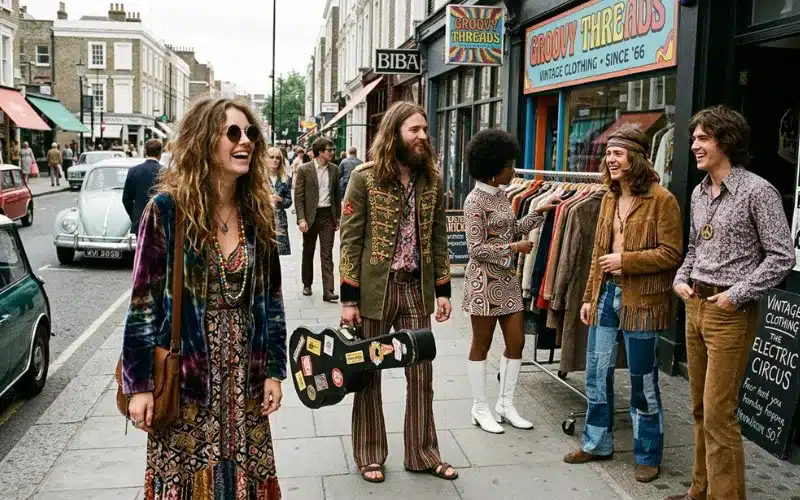
The next major redefinition of American casual style by college students came in the 1960s and was in almost every respect the inverse of the Ivy League aesthetic. Where Ivy League style had been restrained, quality-focused, and implicitly aspirational, the counterculture casual style emerging from campuses like Berkeley, Madison, and Ann Arbor in the mid-1960s was deliberately transgressive, expressive, and anti-establishment in its visual language.
Denim, which had been working-class and rural in its cultural associations, was adopted by college students as a deliberate rejection of the middle-class aspiration encoded in chinos and Oxford shirts. Bell-bottom jeans, heavily patched and embroidered denim jackets, tie-dyed shirts, military surplus clothing, and peasant blouses all entered the campus wardrobe as expressions of political opposition and generational identity rather than simply as comfortable alternatives to formal dress.
The significance of this moment for the history of casual style cannot be overstated. Before the 1960s campus counterculture, denim had genuine class associations that limited its adoption outside working-class and blue-collar contexts. After it, denim was permanently available to every segment of American society as a casual clothing choice, and the cultural authority that had previously been the exclusive property of formal or quality casual dress was now also available to deliberately informal, even anti-fashion dressing.
The counterculture also established a second enduring principle of American casual style: that what you choose not to wear is as meaningful as what you do. Rejecting formal dress conventions as a deliberate statement has been a recurring feature of American casual fashion from the 1960s through to the contemporary quiet luxury rejection of visible branding and the athleisure movement’s rejection of occasion-specific dressing.
Sportswear Goes to Class: 1970s and 1980s
The 1970s and 1980s saw a different kind of campus style innovation as the growing American sportswear industry found its most enthusiastic early adopters among college students who began wearing athletic pieces beyond the gym and the playing field. Running shoes, sweatshirts, track pants, and eventually the early sneaker culture that would eventually become one of the most economically significant segments of the fashion industry all gained their mainstream cultural legitimacy on American college campuses.
Nike’s rise to cultural prominence is directly traceable to its adoption by college athletes and students in the late 1970s. The Nike Cortez, released in 1972, was originally designed as a running shoe. Its adoption as an everyday campus shoe was not planned by the brand but represented an organic process by which college students recognised the functional advantages of athletic footwear for the physical demands of campus life, including walking between classes, carrying books, and navigating campus terrain in varying weather.
The sweatshirt, which had been purely athletic in its associations, underwent a similar transformation during this period. College and university sweatshirts bearing the names and insignia of institutions became some of the most widely worn and culturally legible casual garments in America, a phenomenon that established the principle of wearing identity-signifying casual clothing that remains central to both American casual style and the contemporary streetwear aesthetic.
Hip-Hop, Basketball, and the Streetwear Revolution: 1990s
The 1990s produced what is arguably the most globally influential American campus style movement in history. Hip-hop culture, which had developed on urban streets rather than in educational institutions, intersected with college campuses through the expanding higher education attendance rates of the decade and through the enormous commercial reach of hip-hop music. College students, particularly at historically Black colleges and universities and at large urban universities, became the primary early adopters of hip-hop-influenced streetwear that would eventually reshape the global fashion industry.
Oversized clothing, including baggy jeans, oversized hoodies and sweatshirts, basketball jerseys worn as outer layers, and sports brand collaborations became campus casual wear of the 1990s. The brands that benefited most, including FUBU, Sean John, and the mainstreaming of Nike and Adidas from purely athletic contexts into fashion contexts, built businesses on campus adoption that then expanded outward to broader consumer markets.
The 1990s campus streetwear moment also established a new relationship between athletic brands and casual fashion that has remained definitive ever since. Before this period, wearing athletic brand clothing outside of athletic activity was still considered unusual in many contexts. After it, the categorical distinction between athletic and casual clothing effectively dissolved, producing the athleisure category that would become one of the largest segments of the fashion market in the 2010s and 2020s.
The influence of 1990s campus streetwear on retro and vintage-inspired fashion is visible throughout contemporary dressing, where 1990s silhouettes, brand aesthetics, and styling references recur regularly as sources for contemporary casual collections.
Y2K, Fast Fashion, and the Democratisation of Trend: 2000s
The early 2000s saw American college campuses become accelerators of the fast fashion cycle rather than originators of new aesthetic movements. The emergence of brands like H&M and Zara in American retail, combined with the explosion of fashion-focused media through early internet and reality television, meant that trends could reach campus markets within weeks of appearing on runways or in celebrity contexts. College students, with their combination of fashion consciousness, limited budgets, and willingness to experiment, became the core consumer of fast fashion globally.
This period also saw the emergence of the first distinctly internet-influenced style subcultures on campus, as early fashion forums and websites allowed students to access and participate in niche style communities that were not available to previous generations through local retail and local social contexts alone.
The low-rise jeans, velour tracksuits, and heavily branded casualwear of the early 2000s campus aesthetic have been revisited extensively in decades party outfit ideas from the 2000s contexts, illustrating how specific and recognisable the era’s style vocabulary was even in retrospect.
Streetwear Becomes High Fashion: 2010s
The 2010s produced the most complex and commercially significant intersection of college campus style with the broader fashion industry. The streetwear aesthetic, which had its roots in 1990s campus hip-hop culture, became the dominant language of luxury fashion during this decade as brands including Supreme, Off-White, Palace, and eventually established luxury houses including Louis Vuitton, Gucci, and Balenciaga recognised that the cultural authority of streetwear, particularly as it was adopted and legitimised on American college campuses, represented a commercial opportunity of enormous scale.
College students in this decade were simultaneously the core consumers of genuine streetwear culture, the most active participants in sneaker culture’s expansion from niche interest to mainstream market, and the demographic most likely to adopt and popularise the social media aesthetics that shaped fashion communication globally. Instagram in particular became a campus-driven fashion communication tool that collapsed the time between trend emergence and mass adoption in ways that fundamentally changed how fashion works.
The decade also saw the emergence of the normcore aesthetic, which originated in art school and design school circles before spreading to broader campus populations. Normcore’s deliberate adoption of unremarkable, generic casual clothing was itself a form of style statement rooted in campus intellectual culture, representing a sophisticated rejection of obvious trend participation that drew directly on the counterculture tradition of American campus style that had begun in the 1960s.
The acubi fashion aesthetic that emerged during this period reflects the internet-native campus style communities of the 2010s, which developed and shared highly specific micro-aesthetics across social platforms in ways that previous generations of college students simply had no access to.
Quiet Luxury, Cottagecore, and the Post-Pandemic Campus: 2020s
The COVID-19 pandemic created a specific disruption to the normal campus style cycle by removing the campus itself, the primary physical site where American student style was tested and disseminated, from the equation for over a year. The style consequences of this disruption are still working through the system, but several clear directions have emerged in American campus casual dressing in the years since.
The quiet luxury aesthetic, which prioritises quality over branding, muted and sophisticated colour palettes, and a generally restrained approach to visible consumption, found an enthusiastic campus audience that was in part reacting to the maximalism of the 2010s streetwear moment and in part responding to the economic anxieties of post-pandemic life. The emphasis on quality basics, well-fitted natural fabrics, and an overall casualness that communicates consideration rather than trend participation has clear roots in the original Ivy League aesthetic of a century earlier.
How to start a minimalist wardrobe from scratch in 2026 reflects the same campus-influenced direction: fewer pieces, better quality, a clear aesthetic identity that does not depend on visible branding or obvious trend participation. The wheel of American campus style has, in some respects, come full circle.
The 2020s campus also saw the accelerated growth of sustainability-focused dressing among college students, with thrifting, clothing swaps, and second-hand shopping becoming genuinely mainstream campus activities rather than fringe practices. This shift represents a continuation of the counterculture tradition of using clothing choices to express values, translated into the specific concerns of a generation dealing with climate change and economic inequality.
Why Campus Style Has Always Led Mainstream Fashion
The recurring pattern across a century of American campus style history is that college students consistently solve style problems that the mainstream fashion industry has not yet addressed, and the solutions they develop on campus then spread outward to become the foundations of broader fashion movements.
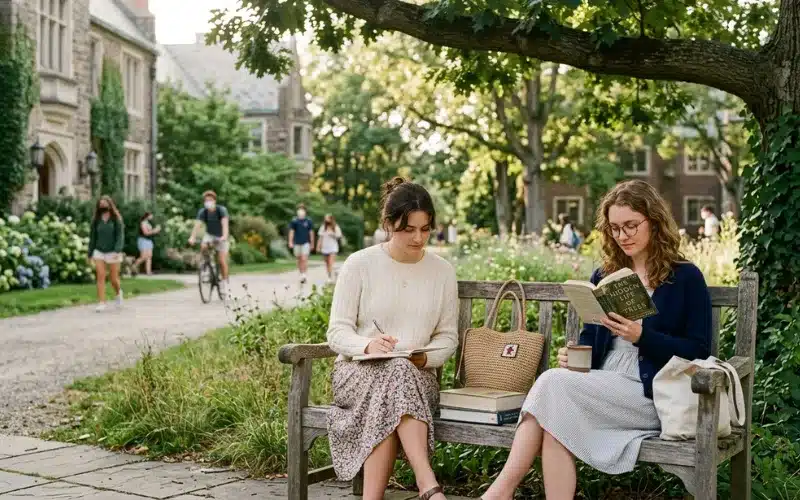
This happens for several specific reasons. College campuses contain high concentrations of young people navigating the same contextual challenges simultaneously, which creates the social conditions for rapid style evolution and adoption. Students have the time, the social motivation, and the relatively low financial stakes to experiment with appearance in ways that working adults often do not. And campuses have historically been the sites of political and cultural movements that use clothing as a communication tool, which means that American campus style has consistently carried ideological weight as well as aesthetic content.
The principle that fit categories and purpose-built garments serve specific social functions is as visible in the history of campus style as anywhere else in fashion. Each generation of college students has developed clothing solutions appropriate to the specific conditions, values, and identity needs of campus life in their era, and those solutions have repeatedly proven relevant and influential well beyond the campus contexts that generated them.
FAQ
When did American college students first influence casual fashion
American college students began influencing mainstream casual fashion in the 1920s and 1930s, when Ivy League students at Harvard, Yale, and Princeton developed the relaxed interpretation of quality casualwear that would become the preppy aesthetic. This was the first time a distinctly campus-generated style vocabulary spread to mainstream American culture and established the principle that casual dressing could be simultaneously comfortable and considered.
How did denim become acceptable as casual clothing in America
Denim’s transition from working-class and rural clothing to mainstream casual wear was primarily driven by college students during the 1960s counterculture movement. Students at campuses including Berkeley and Madison adopted denim as a deliberate rejection of middle-class aspirational dressing, and their cultural visibility and political significance during this period gave denim a new set of associations that made it culturally available to every segment of American society.
What influence did hip-hop have on American campus style
Hip-hop culture’s intersection with college campuses in the 1990s, particularly at historically Black colleges and universities and large urban universities, produced the streetwear aesthetic that would become one of the most commercially significant fashion movements of the following decades. The adoption of oversized silhouettes, athletic brand clothing, and basketball-influenced casual wear by college students gave hip-hop style the mainstream cultural legitimacy that eventually made streetwear the dominant language of both casual fashion and luxury fashion in the 2010s.
What is the quiet luxury trend and where did it come from
Quiet luxury is an aesthetic approach that prioritises quality materials, muted and sophisticated colour palettes, and a generally restrained approach to visible branding and obvious trend participation. It emerged in the early 2020s partly in reaction to the maximalism of 2010s streetwear and partly in response to post-pandemic shifts in values around consumption and display. American college campuses were among the earliest mainstream adopters of this aesthetic, and its emphasis on good basics, natural fabrics, and unfussy styling has clear roots in the original Ivy League casual aesthetic of the 1920s and 1930s.
How has social media changed American campus style
Social media, particularly Instagram from 2010 onward and TikTok from 2019 onward, has fundamentally changed the speed and reach with which American campus style influences broader fashion culture. Trends that previously took years to spread from campus to mainstream now spread in weeks or days. It has also created conditions for highly specific micro-aesthetics and style subcultures to develop and find audiences without the need for local critical mass, which means the number of distinct campus style movements operating simultaneously has increased dramatically compared to any previous era.
Is American campus style still influential in global fashion
Yes. American campus style remains one of the most globally influential aesthetic traditions in fashion, primarily through the continued dominance of American streetwear culture, the global reach of American university branding and iconography, and the platform that American college students have through social media to communicate their style choices to global audiences. The quiet luxury movement, which has significant American campus roots, has become a globally influential aesthetic direction in the 2020s, continuing a pattern of campus-originated American style movements reshaping fashion internationally.