

Blue jeans began as durable work trousers designed for California gold miners in 1873 and have since become the most universally worn garment in human history. The journey from utility workwear to global fashion symbol spans a century and a half of cultural shifts, generational rebellions, technological innovations, and commercial transformations that collectively turned a pair of indigo-dyed denim trousers with copper rivets into the defining casual garment of the modern world. No other piece of clothing has crossed as many social, cultural, economic, and geographic boundaries, and no other garment has been redefined so many times while remaining recognisably itself.
The Origins: Work, Gold, and Denim 1873
The story of blue jeans begins formally on May 20, 1873, when Levi Strauss and Jacob Davis received United States patent number 139,121 for the process of adding copper rivets to points of strain on work trousers. Davis, a Nevada tailor, had been reinforcing the trousers of working men with rivets since 1871 after a customer’s wife complained that her husband kept tearing the pockets of his pants through the physical demands of his work. He approached Strauss, a San Francisco dry goods merchant who supplied the denim fabric Davis used, to share the patent costs and establish a manufacturing operation.
The garment they patented was not blue jeans in the contemporary sense. It was a work trouser in denim or duck fabric, the characteristic indigo blue being the result of the dye used to colour the warp threads of the denim weave, and the rivets being the specific innovation being protected. The term jeans itself derives from Gênes, the French name for Genoa, the Italian port city associated with a heavy cotton textile used by sailors, while denim derives from serge de Nîmes, a fabric from the French city of Nîmes. American workwear was literally clothed in European textile history from its origins.
The early customers for these riveted work trousers were the working men of the American West: miners, cowboys, farmers, and labourers whose physical work destroyed ordinary trousers at the seams and pocket corners. The denim’s durability and the rivets’ reinforcement solved a genuine practical problem and the garment’s early success was entirely functional. There was no fashion intention and no cultural aspiration in the original product, which is precisely what makes its subsequent transformation into one of the most culturally loaded garments in history so remarkable.
Cowboys, Ranchers, and the Western Mythology 1880s to 1930s
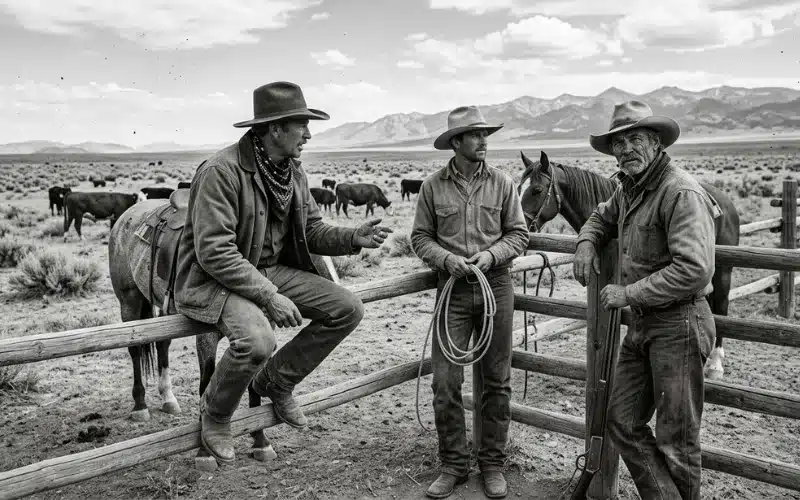
Through the late 19th and early 20th centuries, denim work trousers became associated with a specific American mythology that would prove enormously important to their eventual global appeal. Cowboys and ranch hands across the American West adopted denim as their working uniform, and the image of the cowboy, which was already being heavily romanticised in dime novels, Wild West shows, and eventually in cinema, became inseparable from the blue denim jean.
This association with the American cowboy gave denim work trousers a cultural resonance that extended well beyond their functional qualities. The cowboy was simultaneously a symbol of physical toughness, masculine independence, frontier freedom, and a specifically American way of engaging with landscape and labour that had enormous appeal both within America and internationally. By associating itself with this mythology through constant visual repetition in popular culture, denim accumulated a cultural weight that no marketing campaign could have manufactured.
The dude ranch vacation, which became popular among wealthy Eastern Americans in the 1920s and 1930s, was the first instance of blue jeans being worn outside a working context as a deliberate adoption of Western culture. Wealthy vacationers who visited ranches purchased and wore denim jeans as part of the Western experience, bringing them back East and wearing them in leisure contexts that had nothing to do with the original work function. This was the first step in the long process by which blue jeans moved from workwear into fashion.
The retro and vintage-inspired fashion references that recur consistently in contemporary casual dressing owe a significant debt to this early period of denim mythology, which established the associations of independence, authenticity, and American character that blue jeans continue to carry.
Hollywood, Rebellion, and the 1950s
The transformation of blue jeans from workwear into youth fashion was largely accomplished by Hollywood in the 1950s, and specifically by a small number of films and performers whose adoption of denim made it the uniform of a new kind of American cultural identity that had nothing to do with work.
Marlon Brando in The Wild One in 1953 and James Dean in Rebel Without a Cause in 1955 both appeared in blue jeans in roles that positioned them as symbols of youthful rebellion, alienation, and masculine appeal. The significance of this cultural placement cannot be overstated. These were not working men wearing their work clothes. These were attractive, rebellious young men wearing blue jeans as an expression of their rejection of the conformist, middle-class values of postwar American society.
The response from the middle-class establishment was telling. Many American schools banned blue jeans in this period on the grounds that they were associated with delinquency and rebellion. Some resorts and restaurants refused entry to jeans-wearing patrons. This institutional rejection paradoxically accelerated the adoption of jeans by young people who wanted to signal exactly the values that the establishment was trying to suppress.
By the late 1950s, blue jeans had become the definitive garment of American youth culture, and American youth culture had become one of the most globally influential cultural exports of the postwar period. The two developments were inseparable in their consequences for the global spread of denim.
The Counterculture and the 1960s
The 1960s counterculture transformed blue jeans again, this time from a symbol of individual rebellion into a symbol of collective political and social resistance. The association between denim and the Civil Rights Movement, the anti-Vietnam War movement, the women’s liberation movement, and the broader counterculture gave the garment an explicitly political dimension that further broadened its cultural appeal and deepened its cultural meaning.
The personalisation of jeans through embroidery, patching, dyeing, and other modifications also emerged during this period as a practice through which individuals used the garment as a canvas for self-expression. Heavily patched jeans covered in embroidery and political badges became a specific aesthetic statement that communicated membership in a particular cultural community as clearly as any uniform.
The significance of this period for the global spread of denim was enormous. The American counterculture was globally visible through music, film, and journalism, and its adoption of blue jeans as a central garment gave denim cultural currency in markets that might otherwise have been resistant to an American workwear product. By the late 1960s, blue jeans were being manufactured and worn in Western Europe, Japan, and Australia in volumes that reflected genuine demand rather than simple imitation.
Understanding the history of how campus casual style developed from this counterculture moment helps explain why so many contemporary fashion micro-aesthetics retain traces of the 1960s relationship between clothing and identity politics.
Designer Denim and the 1970s and 1980s
The entry of fashion designers into the denim market in the 1970s and 1980s completed the transformation of blue jeans from workwear into fashion garment. Calvin Klein’s 1980 advertising campaign featuring Brooke Shields with the tagline nothing comes between me and my Calvins was one of the most commercially significant moments in fashion history, simultaneously sexualising jeans, establishing the designer label as a status marker within a previously egalitarian garment category, and demonstrating that jeans could carry aspirational values as easily as any luxury product.
Gloria Vanderbilt, Jordache, Sergio Valente, and Sassoon Jeans all launched major designer denim lines during this period, and the competition between brands to establish premium positioning within the jeans category created the conditions for the luxury denim market that continues to operate today. The copper rivet that Jacob Davis had patented a century earlier now sat on trousers selling at multiples of their functional equivalent’s price, and the purchaser was paying not for durability but for identity.
The 1970s also saw the emergence of the first fashion-specific cuts and silhouettes in jeans, moving beyond the straight-leg and flared workwear-derived shapes into more deliberately body-conscious designs. The skinny jean, the high-waisted jean, and the wide-leg jean all emerged during this period as designers recognised that the denim trouser was as available for fashion silhouette manipulation as any other fabric.
Global Spread and Cultural Adaptation 1980s to 2000s
By the 1980s, blue jeans had become genuinely global in their reach, but the way they were worn and what they meant differed significantly across cultures. In the Soviet Union and Eastern European countries, American jeans represented Western freedom and consumer culture in a way that made them objects of desire beyond their functional or fashion value. People wore jeans at significant personal and financial cost that in some cases required black market purchases.
In Japan, the relationship with American denim developed into one of the most serious and technically sophisticated craft traditions in the history of the garment. Japanese denim enthusiasts and manufacturers studied American selvedge denim production with an intensity that preserved craft techniques that had largely been abandoned in America itself. The result was a Japanese selvedge denim industry that is now widely regarded as producing the finest quality denim in the world, and that maintains a relationship with the heritage of American workwear that is more faithful than the American industry itself.
The best selvedge denim brands for Americana style reflect this Japanese contribution to the denim tradition and the ongoing significance of the Japan-America dialogue in denim culture.
In the 1990s, hip-hop culture transformed jeans once again. The baggy, low-slung, and oversized jeans aesthetic that developed from hip-hop fashion in American cities became one of the most globally influential casual style movements of the decade and introduced a new generation of jeans silhouettes that departed radically from the fitted, body-conscious styles that had dominated the designer denim era.
Denim in the 21st Century: Luxury, Sustainability, and the Athleisure Challenge
The 2000s and 2010s saw the most complex and fragmented period in the history of blue jeans as a garment category. Premium denim brands including True Religion, 7 For All Mankind, and Citizens of Humanity built businesses on the proposition that jeans could be luxury products sold at hundreds of dollars per pair. At the same time, fast fashion brands produced jeans at price points of under twenty dollars that made the garment more widely accessible than at any point in its history.
The decade of the 2010s also brought the most serious challenge the blue jean had ever faced as a dominant casual garment: the rise of athleisure and the widespread adoption of leggings, joggers, and performance fabric trousers as everyday casual wear. Jeans sales declined significantly during this period as comfort-focused consumers chose stretch fabrics over the relatively rigid structure of denim.
The industry responded with stretch denim innovations that added elastane and other performance fibres to the weave, producing jeans that offered significantly more comfort and movement flexibility than traditional rigid denim. This adaptation preserved jeans’ market position while changing the character of the product in ways that traditionalists and denim enthusiasts found controversial.
Understanding how fit categories in clothing have evolved to include the stretch and skinny jeans innovations of the 2000s and 2010s reflects the commercial pressure that denim faced from athleisure and the industry’s response to it.
The sustainability conversation has become increasingly central to denim in the 2020s. Conventional denim production is water-intensive, chemically demanding, and labour-intensive in ways that raise significant ethical and environmental concerns. The industry has responded with water-saving dyeing technologies, organic cotton programmes, recycled denim initiatives, and various supply chain transparency efforts. Sustainable approaches to clothing care and maintenance apply directly to denim, where washing less frequently and at lower temperatures significantly reduces the environmental impact of a wardrobe built around blue jeans.
What Blue Jeans Mean Now
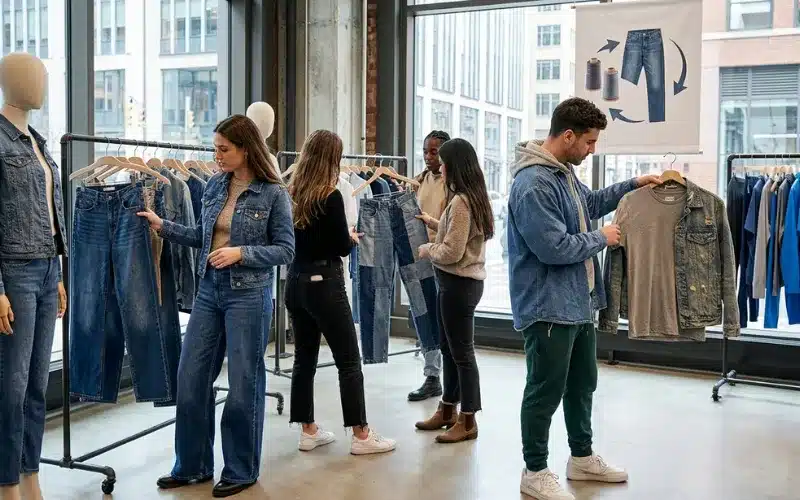
Blue jeans in 2026 occupy every position simultaneously in the fashion landscape. They are worn by presidents and labourers, by fashion designers and school children, by people in virtually every country on earth. They are available at price points from under twenty dollars to over a thousand dollars. They are produced in a dozen major silhouettes and hundreds of minor variations. They carry the cultural memory of gold miners and cowboys, of 1950s rebellion and 1960s counterculture, of disco and hip-hop and quiet luxury simultaneously.
This extraordinary breadth of meaning and application is both the legacy of a century and a half of cultural accumulation and the explanation for why blue jeans have remained the world’s most widely worn garment through technological, social, and fashion changes that have made most other clothing categories unrecognisable from their 19th century predecessors.
Modern casual styling built around blue jeans as a foundation continues the tradition that began in 1873, finding new ways to express the same enduring qualities of durability, authenticity, and democratic accessibility that made the original riveted work trouser so compelling in the first place.
FAQ
Who invented blue jeans and when
Blue jeans were invented by Levi Strauss and Jacob Davis, who received United States patent number 139,121 on May 20, 1873 for the process of adding copper rivets to points of strain on work trousers. Davis, a Nevada tailor, developed the riveting technique and approached Strauss, his fabric supplier, to share the patent costs and establish manufacturing. The garment was originally designed for the working men of the American West, particularly miners and labourers, and had no fashion intention in its original conception.
When did jeans become a fashion item rather than workwear
The transition from workwear to fashion garment began in the 1930s with the popularisation of dude ranch vacations, accelerated significantly in the 1950s through Hollywood films featuring Marlon Brando and James Dean, and was effectively complete by the late 1960s when designer fashion houses began producing jeans as deliberate fashion garments. The entry of Calvin Klein and other major designers into the denim market in the late 1970s and 1980s fully established jeans as a fashion and luxury category.
Why are jeans called jeans
The word jeans derives from Gênes, the French name for Genoa, the Italian port city that was associated with a heavy cotton textile used by sailors and traders in the early modern period. The term was applied to cotton twill trousers produced from similar fabrics. The word denim derives from serge de Nîmes, a fabric associated with the French city of Nîmes. Both terms entered the English language through the textile trade before the garment we now call jeans was invented.
How did jeans spread globally
Jeans spread globally through a combination of American cultural influence via Hollywood films, music, and popular culture; the specific appeal of jeans in countries including the Soviet Union where they represented Western freedom and consumer culture; and the enormous commercial reach of American fashion brands from the 1970s onward. Japan developed its own sophisticated relationship with American denim that produced some of the finest denim manufacturing in the world. By the 1980s, blue jeans were genuinely global in their reach and cultural significance.
How has denim changed from its original form
Original denim was a rigid, heavyweight fabric woven on shuttle looms using indigo-dyed warp threads and undyed weft threads, producing a characteristically blue face and white interior. Contemporary denim varies enormously from this original: stretch denim incorporates elastane for comfort and movement, lightweight denim sacrifices durability for comfort, raw denim preserves the original unwashed character, and performance denim adds moisture management and other technical properties. The silhouettes have expanded from the original straight workwear cut into skinny, wide-leg, flared, cropped, and many other shapes. The price range now spans from ultra-cheap fast fashion to thousand-dollar luxury products.
Is denim sustainable
Conventional denim production raises significant sustainability concerns, particularly around water consumption in cotton growing and dyeing processes, chemical use in various finishing treatments, and labour practices in global supply chains. The industry is responding with water-saving technologies, organic and recycled cotton programmes, and supply chain transparency initiatives. At the individual level, wearing jeans for longer before washing, washing in cold water, and air drying significantly reduces the environmental impact of denim in the wardrobe. Buying higher quality jeans that last longer and avoiding very fast fashion denim that wears out quickly are the most impactful individual sustainability choices in denim consumption.