Best Eco-Friendly Fabrics for Hot Humid Weather
Updated: 03 Mar 2026
Dressing for hot, humid weather is one of fashion’s more underappreciated challenges. It’s not just about staying cool , it’s about staying dry, comfortable, and presentable when the air itself feels like a wet blanket. Most people’s instinct is to grab whatever feels lightest, which usually means reaching for cheap synthetic fabrics that promise breathability but end up trapping heat, holding moisture, and developing a smell by midday.
The good news is that the most breathable, moisture-managing fabrics available are also among the most sustainable ones. Nature had thousands of years to solve the problem of heat and humidity before synthetic fibres existed, and the results are still unmatched.
Why Fabric Choice Matters More in Humid Climates
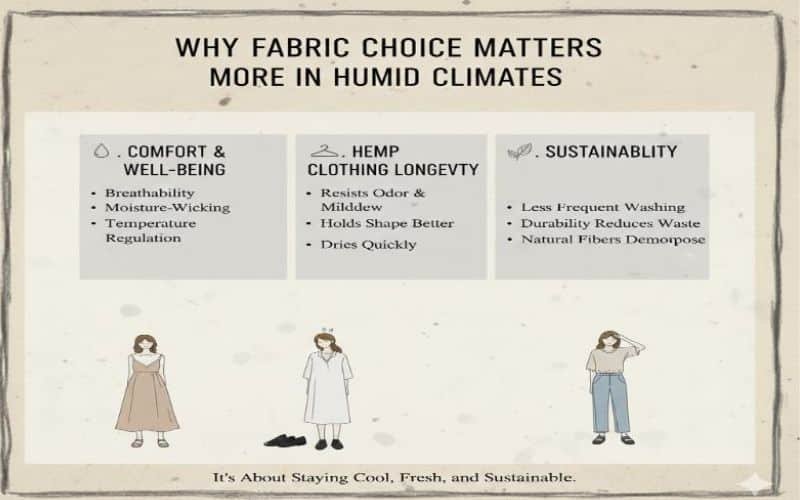
In a dry climate, even moderately breathable fabrics can work. In a humid one, the rules change entirely. When the air is already saturated with moisture, your body’s primary cooling mechanism , sweat evaporation , is severely compromised. The fabric against your skin becomes critical because it determines whether sweat moves away from your body (wicking) or sits against it (trapping heat and increasing discomfort).
Synthetic fabrics like polyester and nylon are hydrophobic , they repel water rather than absorbing it, which means sweat stays on the skin’s surface rather than moving through the fabric. In dry heat, this can sometimes work in your favour. In humid heat, it makes everything significantly worse. Natural and semi-synthetic eco-friendly fabrics, by contrast, are generally hydrophilic , they absorb and release moisture , and their open fibre structures allow air to move through the weave. That physical difference is what makes sustainable fabrics for summer so much more effective in humid conditions than most synthetic alternatives.
The Science Behind Breathability , What You’re Actually Looking For
Before diving into specific fabrics, it helps to understand what breathability actually means technically, because the word is used loosely in fashion. True breathability in a fabric comes from two properties working together: moisture absorption (how much water the fibre can take in relative to its weight, expressed as moisture regain percentage) and air permeability (how freely air moves through the weave structure). A fabric that scores well on both will feel genuinely cool in humid conditions.
- Moisture regained: linen absorbs up to 20% of its weight in moisture before feeling wet; cotton absorbs 8–9%; Tencel lyocell absorbs up to 11–13%. By comparison, polyester absorbs less than 0.4%.
- Air permeability: looser, open weaves allow more airflow. A plain-weave linen allows significantly more air movement than a tight-weave cotton poplin, even though both are natural fibres.
- Thermal conductivity: linen and cotton conduct heat away from the body more efficiently than wool or synthetics, which is why they feel cooler to the touch in high temperatures.
- Wicking vs. absorbing: some fabrics (linen, Tencel) wick moisture to the surface where it evaporates; others (cotton) absorb and hold it. In humid conditions, fast-evaporating wicking fibres tend to feel drier.
The Best Eco-Friendly Fabrics for Hot Humid Weather
The following fabrics represent the strongest intersection of environmental responsibility and genuine performance in heat and humidity. Each comes with its own set of strengths, care requirements, and ideal styling applications, so rather than treating them as interchangeable, it helps to understand what each one does best.
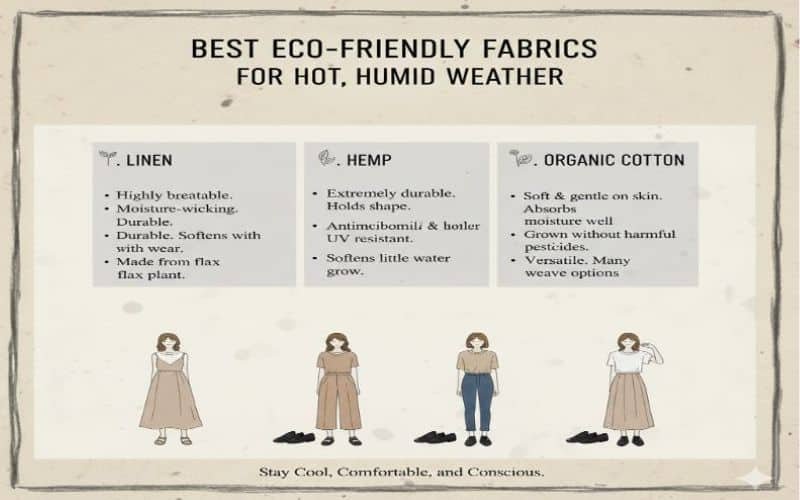
1. Linen , The Gold Standard for Humid Heat
If there is one fabric that was essentially designed for hot, humid climates, it is linen. Made from the fibres of the flax plant, linen has been used for hot-weather clothing for thousands of years , and the reason it has lasted is simple: nothing beats it in genuine humid-heat performance. Linen absorbs up to 20% of its own weight in moisture before feeling damp, it wicks that moisture to the surface quickly where it evaporates, and its naturally hollow fibre structure allows exceptional airflow through even a tightly woven fabric.
From a sustainability perspective, flax is one of the lowest-impact crops available. It requires minimal irrigation (often growing entirely on rainwater), no pesticides, and almost the entire plant is usable with very little waste. European flax , particularly from France, Belgium, and the Netherlands , is held to some of the strictest agricultural standards in the world, and OEKO-TEX certified linen is widely available at accessible price points.
- Best for: Shirts, wide-leg trousers, midi dresses, blazers for warm-weather office environments.
- Care note: Linen wrinkles significantly. Embracing a loose, relaxed fit rather than fighting it , the wrinkling is actually part of the fabric’s thermal appeal, as the textured surface increases airflow.
- Body type guidance: Linen drapes well on most frames. Stiffer weaves add structure and are flattering for straight or rectangular body types; softer, washed linen drapes more softly and suits curvier silhouettes.
2. Organic Cotton , Reliable, Versatile, Accessible
Organic cotton is not as breathable as linen in peak humidity, but it remains one of the most practical sustainable fabrics for summer because of its softness, versatility, and wide availability across price points. The critical distinction here is organic versus conventional: conventional cotton is one of the most pesticide-intensive crops in the world, accounting for roughly 16% of all insecticide use globally despite covering only 2.5% of agricultural land. Organic cotton (GOTS certified) is grown without synthetic pesticides or fertilisers, with significantly lower water consumption , and it performs identically to conventional cotton from a comfort perspective.
For humid heat, the best organic cotton weaves are the loosest and lightest: voile, lawn, gauze, and seersucker. These open weaves allow substantially more airflow than poplin or jersey, making the difference between a cotton shirt that feels stifling and one that genuinely breathes. A loosely woven organic cotton voile dress in a light colour is one of the most practical pieces you can own for a humid summer climate.
- Moisture gain: 8–9%, lower than linen but significantly higher than any synthetic.
- Best weaves for humidity: gauze, seersucker, voile, lawn , in that order of breathability.
- Avoid heat: thick jersey, dense poplin, or Oxford weave cotton , these hold heat and moisture rather than releasing it.
3. Tencel Lyocell , The Best Modern Sustainable Option
Tencel lyocell has quietly become one of the most genuinely impressive eco-friendly fabrics for hot humid weather available in contemporary fashion. Made from wood pulp (typically eucalyptus or beech) processed in a closed-loop system that recaptures 99% of the solvent used, Tencel has one of the lowest environmental footprints of any manufactured fibre. More importantly for hot weather dressing, it outperforms cotton in moisture management: it absorbs up to 50% more moisture than cotton, releases it quickly, and its smooth fibre surface inhibits bacterial growth , which means it stays odor-free significantly longer than cotton in sweaty conditions.
The feel of Tencel is often compared to a blend between silk and cotton , smooth, soft, with a slight sheen , and it drapes beautifully, making it particularly well-suited to flowy silhouettes like wide-leg trousers, wrap dresses, and oversized shirts. For anyone building a breathable natural fabric wardrobe for a humid climate, Tencel is the highest-performing modern option available at a sustainable price point.
- Environmental credentials: closed-loop production, biodegradable, often OEKO-TEX certified.
- Performance: faster moisture release than cotton, naturally odour-resistant, stays cooler longer.
- Best for: Flowy dresses, lightweight trousers, oversized shirts, travel clothing for tropical climates.
4. Hemp , Underrated, Highly Sustainable, Increasingly Wearable
Hemp has a complicated reputation in fashion, largely because early hemp textiles were coarse and scratchy. Modern hemp processing has largely solved that problem, and hemp fabric now ranges from rough canvas-style weaves to genuinely soft, fine-gauge textiles suitable for everyday wear. From a sustainability perspective, hemp is extraordinary: it requires no pesticides, regenerates the soil it grows in, sequesters carbon, and uses roughly half the water of conventional cotton per kilogram of fibre produced.
For humid heat, hemp performs similarly to linen , strong moisture absorption, excellent breathability, and a natural resistance to mildew and bacteria that makes it well-suited to consistently humid environments. Like linen, it softens and improves with each wash, making it a genuinely long-lasting fabric choice. The styling approach for hemp is broadly similar to linen: loose, relaxed silhouettes in light or mid-toned colours work best.
5. Bamboo Viscose , With Important Caveats
Bamboo viscose is often marketed as a premium sustainable fabric for hot weather, and its performance credentials are real: it is exceptionally soft, moisture-wicking, and naturally antibacterial. However, the sustainability credentials of bamboo viscose require careful scrutiny. The bamboo plant itself is highly sustainable , it grows rapidly without pesticides and requires no irrigation. The problem is the processing: converting bamboo into viscose fibre uses a chemical process that, unless it operates in a closed-loop system similar to Tencel, releases harmful solvents into the environment. Bamboo lyocell (as opposed to bamboo viscose) uses the cleaner closed-loop process and is the more genuinely sustainable version.
- If buying bamboo fabric: look for bamboo lyocell specifically, or OEKO-TEX certification confirming no harmful chemical residues.
- Performance: excellent moisture wicking, softer than cotton, naturally temperature-regulating.
- Best for: Activewear, loungewear, lightweight layering pieces for travel.
Fabrics to Avoid in Hot Humid Conditions
Knowing what not to wear in humid heat is as important as knowing what to wear. Several common fabrics , including some that are marketed as lightweight or breathable , perform poorly once humidity is factored in. Understanding why helps you make faster, more confident decisions at the point of purchase.
- Polyester: hydrophobic, traps heat and moisture against the skin, holds odour. Avoid in all humid conditions regardless of how ‘lightweight’ the weave is.
- Nylon: similar to polyester, with high thermal insulation that works against you in heat.
- Modal (standard): softer and more sustainable than cotton but holds moisture rather than wicking it , better for dry heat than humid.
- Thick denim: cotton-based but the weave is too dense for effective airflow. In humid conditions, denim becomes heavy and slow-drying.
- Acetate and rayon blends: inconsistent moisture management and often chemically intensive in production; avoid unless certified.
How to Build a Hot-Weather Eco-Friendly Wardrobe
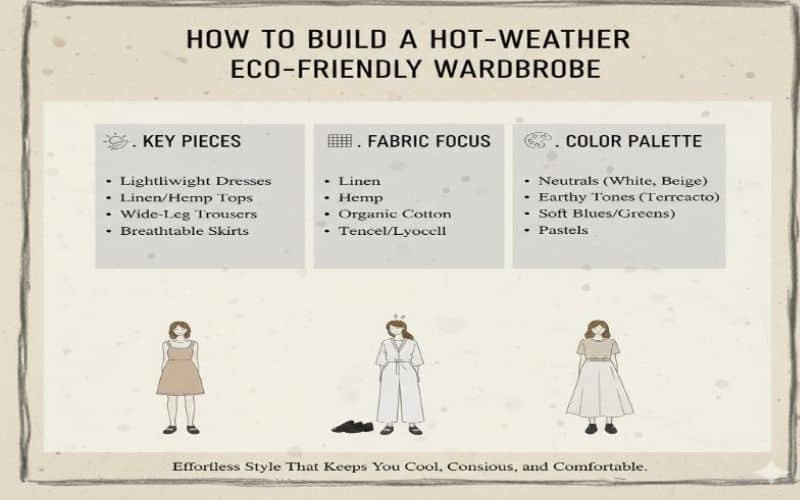
Knowing which eco-friendly fabrics to choose is the foundation, but building a functional hot-weather wardrobe around them requires thinking about silhouette, colour, and versatility as well. The fabrics discussed above all perform best in looser, more relaxed silhouettes , tight fits restrict airflow regardless of how breathable the fabric is. For humid climates, the styling principle is: loose but intentional. Oversized doesn’t mean shapeless; it means choosing pieces where the fabric skims the body rather than clinging to it.
Colour also matters more than people often realise. Light colours reflect heat rather than absorbing it, and in fabrics like linen and organic cotton, the difference between wearing white or off-white versus navy or dark green is genuinely perceptible in full sun. For a practical humid-weather capsule wardrobe, anchoring your palette in sand, ivory, sage, and soft terracotta gives you heat-reflective colours that also coordinate easily.
- Core pieces to prioritise: a loose linen shirt, wide-leg linen or Tencel trousers, a flowy organic cotton or Tencel midi dress, lightweight hemp or linen shorts, and a lightweight Tencel layer for air-conditioned environments.
- Budget guidance: linen and organic cotton are the most accessible price points; Tencel sits in the mid-range; hemp and bamboo lyocell tend to be slightly higher due to production complexity.
- Care tip: wash eco-friendly fabrics in cold water to preserve fibre integrity, reduce energy use, and minimise microfibre shedding where relevant.
Scenario Guide , What to Wear and When
The best way to understand how these fabrics translate into real outfit decisions is to think through specific humid-weather scenarios. The following combinations apply the fabric knowledge above to practical situations, giving you a starting point for building looks that actually work.
For a long day of outdoor activity in tropical heat , a market, a travel day, a coastal town , a loose organic cotton gauze or linen shirt in ivory or sand over wide-leg linen trousers is the most functional combination available. The linen absorbs and releases moisture continuously, the loose silhouette allows airflow, and the light colour reflects radiant heat. Add flat leather sandals rather than closed shoes; foot temperature contributes significantly to overall body heat perception.
For a smart-casual or business setting in a humid climate , a meeting, a dinner, a cultural site with a dress code , Tencel wide-leg trousers with a linen or Tencel blouse and minimal accessories reads as polished without sacrificing comfort. The smooth surface of Tencel resists visible sweat marks better than cotton or linen, making it the more reliable choice for situations where appearance needs to stay controlled throughout the day. For cooler indoor environments where air conditioning is aggressive, a lightweight hemp or Tencel cardigan provides a layer that folds flat and doesn’t add significant bulk to a bag.
Final Thought , Sustainability and Comfort Are the Same Argument
The most important insight about eco-friendly fabrics for hot humid weather is this: the environmental argument and the comfort argument point in exactly the same direction. The fabrics that have the lowest impact on the planet are the same ones that have the lowest impact on your body in heat and humidity. Linen, organic cotton, Tencel lyocell, and hemp are not compromises , they are genuinely the best materials available for warm-weather dressing, and they have been for longer than synthetic textiles have existed.
Building a sustainable breathable clothing wardrobe for a humid climate is not about restriction. It is about understanding your materials well enough to choose them confidently, style them properly, and invest in pieces that earn their place in your wardrobe by performing better and lasting longer than anything a polyester blend could offer. That is a wardrobe decision and a sustainability decision , and in this case, they are exactly the same thing.