How to Start a Minimalist Wardrobe from Scratch in 2026
Updated: 03 Mar 2026
There has never been a better or more necessary moment to start a minimalist wardrobe from scratch. In 2026, the average person owns more clothing than at any point in history , and wears only a fraction of it. Fast fashion has made it easy to accumulate, but that accumulation comes with a cost: financial, environmental, and psychological. Every morning spent standing in front of a packed wardrobe feeling like you have nothing to wear is a symptom of the same problem. You don’t need more clothes. You need fewer, better ones.
Starting a minimalist wardrobe from scratch is not about stripping your life down to five grey T-shirts or following someone else’s numbered list of essentials. It is a deliberate process of building a wardrobe that reflects your actual lifestyle, fits your body properly, and gives you more outfit options from fewer pieces than you thought possible. This guide walks you through the entire process , from clearing out to building up , with the practical logic behind every decision.
What a Minimalist Wardrobe Actually Means in 2026
The definition of a minimalist wardrobe has evolved significantly from the rigid capsule wardrobe formulas that dominated fashion blogs a decade ago. In 2026, minimalism in fashion is less about a fixed number of pieces and more about intentionality , owning only what you genuinely wear, what fits you well, and what works across multiple contexts in your real life. It is not an aesthetic. It is a system.
For some people, a functional minimalist wardrobe contains 25 pieces. For others, it is 40. The number is less important than the principle: every item earns its place by being worn regularly, combining easily with other pieces, and fitting your body in a way that makes you feel confident. A wardrobe of 50 pieces that all meet that standard is infinitely more minimalist in practice than a wardrobe of 15 pieces that mostly sit unworn because they were bought on impulse or don’t fit quite right.
Audit What You Already Own Before You Buy Anything
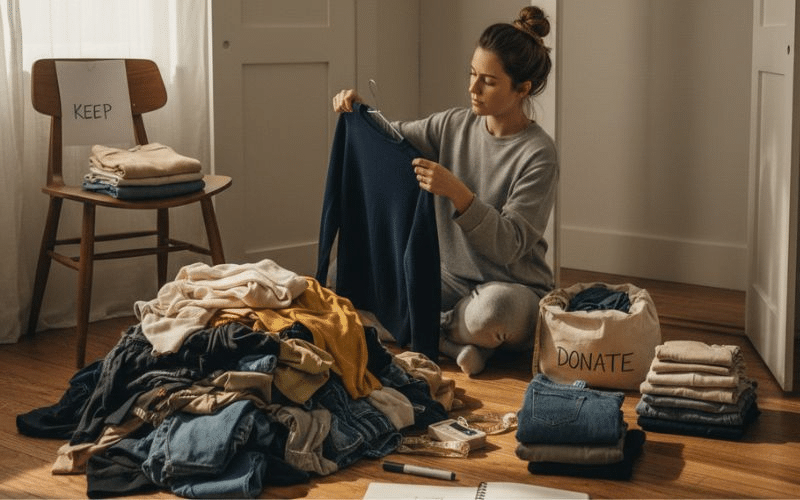
The single most common mistake people make when trying to build a minimalist wardrobe is buying new things before properly evaluating what they already have. Before any decluttering or shopping happens, a wardrobe audit gives you accurate data about your actual habits, not your aspirational ones.
Set aside two to three hours and pull everything out of your wardrobe. As you go through each piece, ask three questions: Have I worn this in the past twelve months? Does it fit my body right now , not a future version of my body, but today? Does it go with at least three other things I own? If the answer to any of those three questions is no, that piece does not belong in a minimalist wardrobe. It belongs in a donation bag, a sell pile, or the bin.
- Items worn in the past year: these are your actual wardrobe, regardless of what you think you like.
- Items never worn or worn once: be honest about why. Impulse buy, wrong fit, aspirational purchase, or genuine gap-filler?
- Items with fit issues: poor fit is the number-one reason clothing goes unworn. Note what the fit problem is , too long, too wide, gaps at the shoulder , before deciding whether tailoring is worth the cost.
- Items in excellent condition: these are your rebuild candidates. Even if a piece doesn’t suit your current direction, condition tells you the quality level you respond well to.
After the audit, you will almost certainly have fewer pieces than you started with , and a much clearer picture of what you actually need versus what you thought you needed.
Define Your Lifestyle Before Choosing Your Pieces
A minimalist wardrobe built for the wrong lifestyle is just an expensive mistake with fewer items. Before selecting any pieces, you need an accurate breakdown of where you actually spend your time. Not where you used to spend it, not where you wish you spent it , where your week genuinely goes.
Think in percentages across a typical week. If you work from home for four days and go out twice, roughly 60% of your wardrobe should support comfortable, functional home-working, and 40% should cover going out. If you have a physical job five days a week, practical durability matters more than elevated polish. If your life is genuinely split between formal and casual environments, your minimalist wardrobe needs a core of pieces that bridge both rather than two separate sub-wardrobes competing for the same space.
- Work from home: comfortable but pulled-together. Relaxed trousers, quality knitwear, clean casual tops that look presentable on a video call.
- Office or client-facing work: structured pieces with versatile credentials , a blazer that works with both trousers and jeans, dresses that move from desk to dinner.
- Active lifestyle: functional pieces that don’t sacrifice aesthetics , quality jersey, durable denim, versatile sneakers.
- Social and evening: a few elevated pieces that work hard across multiple event types rather than single-occasion items.
Build Your Colour Palette First
Before buying a single piece, choosing a colour palette is the structural decision that determines whether your minimalist wardrobe actually works as a system or just a collection of individual items. A cohesive palette means every piece you own goes with every other piece , which is the mechanical engine behind getting 30 or 40 outfits from 20 items.
The most reliable starting point is two or three neutrals as your base, plus one or two accent colours that complement your skin tone and suit the contexts you dress for. Neutrals that coordinate exceptionally well across 2026 minimalist wardrobes include camel, navy, off-white, charcoal grey, warm taupe, and black. Pick the two or three that feel most natural to you and commit to them as your foundation , these should cover approximately 70-80% of your wardrobe.
- Warm skin tones: camel, cream, warm brown, rust, olive, and terracotta work exceptionally well as both neutrals and accents.
- Cool skin tones: navy, charcoal, cool grey, white, dusty rose, and sage read naturally.
- Accent colours: choose one or two that bring genuine energy to your palette , forest green, burgundy, cobalt, or dusty blue all integrate cleanly into a neutral base without creating coordination problems.
- The test: every piece you own should go with at least three other items in your wardrobe. If it only pairs with one thing, it is not earning its place.
The Core Pieces of a Minimalist Wardrobe in 2026
With your lifestyle breakdown and colour palette in place, you are ready to identify the specific pieces your minimalist wardrobe needs. Rather than a generic checklist, the following framework is structured around function , what each piece needs to do , so you can apply it to your specific palette and lifestyle rather than following a formula that may not fit your life.
Foundation Tops – Versatility Over Volume
You need fewer tops than you think, but better ones. Three to five quality tops , a fitted or relaxed T-shirt in a neutral, a button-down shirt, a fine-knit sweater, and one elevated option like a silk or satin blouse , cover the majority of dressing scenarios most people encounter. The guiding principle is that every top should work with every bottom in your wardrobe. If a top only works with one or two things, it is a specialist piece and should be evaluated carefully before inclusion.
Bottoms – The Structural Anchors
Two to three pairs of trousers or a combination of trousers and skirts, plus one or two pairs of well-fitted denim, cover almost everything a minimalist wardrobe needs at the bottom half. Fit is paramount here , more so than for tops, because poorly fitting trousers or skirts visually anchor the entire outfit in the wrong direction. Wide-leg trousers in a neutral are among the most versatile minimalist wardrobe pieces available in 2026, working equally well for office, casual, and evening contexts depending on what they are paired with.
- The two-trouser rule: one tailored neutral (black, navy, or camel) and one relaxed wide-leg or straight-leg pair covers the vast majority of contexts.
- Denim: one dark-wash pair and one mid-wash pair replaces the need for multiple casual-trouser alternatives. Keep cuts consistent with your body type , straight-leg and wide-leg styles flatter the broadest range of proportions.
- Skirts: a straight-cut midi in a neutral or a wrap-style midi are the most versatile single skirt options in a minimalist wardrobe.
Layering Pieces – Where Minimalist Wardrobes Earn Their Keep
Layering pieces are what multiply the number of outfits a minimalist wardrobe can produce. A single good blazer, a well-cut coat, and one or two lightweight layers , a cardigan, a denim jacket, a lightweight trench , do more work than any other category. In 2026, the strongest minimalist layering investments are a tailored blazer in a neutral that works with both casual and formal pieces, and an overcoat or trench that pulls every outfit together when you step outside.
Shoes – Three Pairs That Cover Everything
Footwear is the category where most people over-invest in minimalist wardrobe building. Three pairs of genuinely versatile shoes cover the full range of daily dressing needs: a clean, minimal sneaker or leather flat for casual and active days, a leather loafer or block-heel for smart-casual and office contexts, and one elevated option , a simple heel or ankle boot , for evenings and more formal occasions. All three should exist within your colour palette, which means they integrate with every outfit automatically rather than requiring coordination decisions.
Hands sorting clothes and shoes on a bed, showing careful assessment before buying more.
Starting a minimalist wardrobe from scratch does not require a large upfront investment, but it does require a clear strategy for where to spend and where to save. The principle is simple: invest in quality for the pieces that carry the most weight in your wardrobe, and save on the pieces that are lower-stakes or easily replaceable.
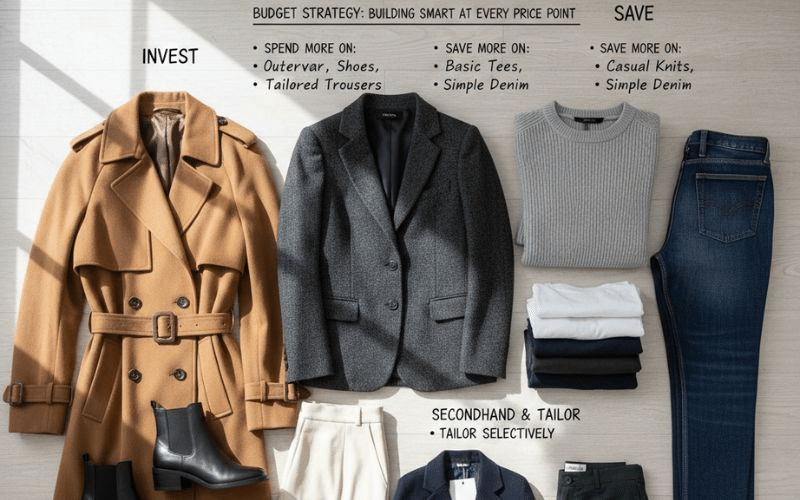
The highest-value investments in a minimalist wardrobe are outerwear (worn over everything, visible in every context), shoes (quality footwear lasts significantly longer than budget alternatives and affects posture and daily comfort), and one or two core neutral pieces like a blazer or trousers that anchor most of your outfits. These are the pieces worth stretching the budget on, because the cost-per-wear calculation over two to three years consistently justifies the premium.
- Spend more on: outerwear, shoes, blazers, tailored trousers , pieces worn frequently and visible from the outside.
- Save more on: basic tees, casual knits, simple denim , pieces worn closer to the body where fit matters more than brand.
- Use secondhand strategically: quality blazers, coats, and tailored trousers from ethical or premium brands appear regularly on ThredUp, Vinted, and Poshmark at 30–60% below retail.
- Tailor selectively: a $20–$30 tailoring alteration on a $60 pair of trousers can produce a result that looks significantly more expensive and fits far better than anything new at that price.
Fabric Choices That Make a Minimalist Wardrobe Last
One of the defining principles of minimalist wardrobe building in 2026 is longevity , choosing pieces that hold their quality, shape, and relevance over multiple years rather than single seasons. Fabric is where that longevity is won or lost. The strongest performers in terms of durability, appearance retention, and long-term cost-effectiveness are wool and wool blends (for knitwear and tailoring), cotton poplin and Oxford (for shirts and structured basics), Tencel lyocell (for flowy tops and trousers), quality denim (for bottoms), and leather or leather-look for shoes and bags.
Fabrics to approach with caution in a minimalist wardrobe include thin polyester (pills quickly, holds odour, loses shape), viscose or rayon without structure (shrinks and distorts after washing), and loosely woven jersey blends that lose their shape after a few wears. The best check before purchasing is tactile: does the fabric have enough weight to hold its structure? Does it recover quickly when stretched? A fabric that does both will serve a minimalist wardrobe well. One that does neither will underperform regardless of how good it looks on the hanger.
Scenario Outfits – What Your Minimalist Wardrobe Looks Like in Practice
The real proof of a minimalist wardrobe is how it performs across the actual situations you dress for every day. The following scenarios demonstrate how a single cohesive wardrobe of around 25 pieces can produce genuinely distinct, context-appropriate looks without requiring separate outfit systems for different parts of life.
For a work-from-home day with an afternoon video call, a fine-knit sweater in a warm neutral over straight-leg trousers reads relaxed but professional , no one on the call questions your credibility, and you are genuinely comfortable through the morning. The same sweater over a collared shirt with the shirt collar visible at the neck creates a slightly elevated version of the same look for a more important call. Neither requires buying anything new; they use the same pieces differently.
For a weekend that runs from errands to a casual dinner, dark-wash jeans with a linen or cotton button-down worn half-tucked, a leather loafer, and a light trench coat over the top covers both contexts without a wardrobe change. The trench coat is the variable , on or off, it shifts the formality of the same outfit enough to suit both settings. This is exactly what a well-built minimalist wardrobe is designed to do.
The Real Goal – A Wardrobe That Works Without Effort
Starting a minimalist wardrobe from scratch in 2026 is ultimately about reclaiming something that most people have lost in the noise of trend cycles and impulse shopping: a wardrobe that you actually trust. One where you open the doors in the morning knowing that whatever you pick will fit, will coordinate, and will be right for where you are going. That feeling , which sounds simple but is surprisingly rare , is what a genuinely minimalist wardrobe delivers.
The process takes longer than a single weekend shopping trip. It requires honesty about what you actually wear versus what you think you wear, patience with building slowly rather than buying everything at once, and a willingness to invest more thoughtfully in fewer pieces. But the result , a smaller, smarter, more functional wardrobe that costs less to maintain, takes less time every morning, and produces better outfits consistently , is one of the most practical improvements you can make to daily life. And in 2026, when the alternative is an endless scroll of things you don’t need, that clarity is worth considerably more than it looks.